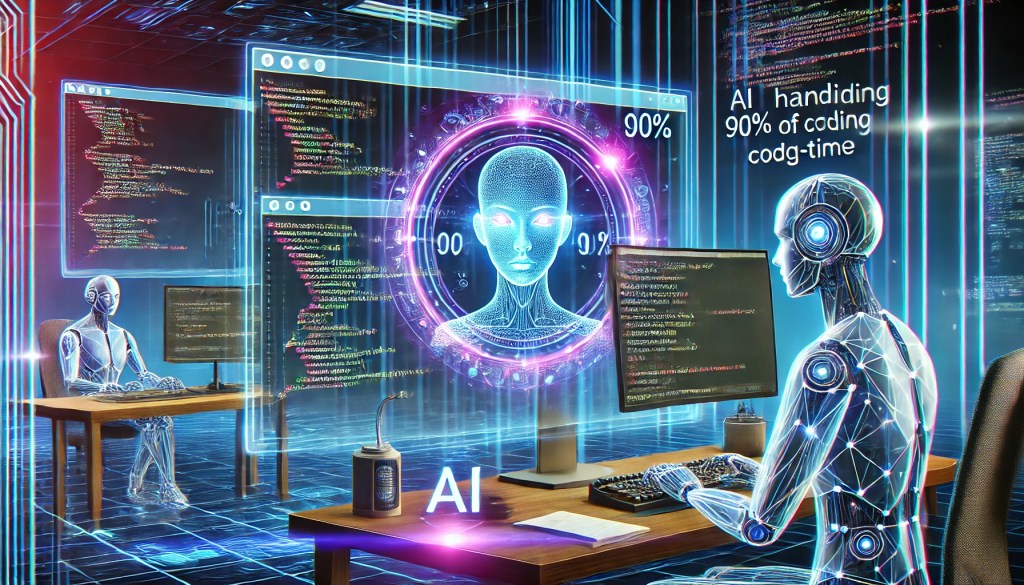
The software development industry is on the verge of a massive transformation. According to recent predictions, AI will be capable of handling up to 90% of coding tasks within the next 3 to 6 months. This rapid advancement in AI-driven code generation is poised to redefine how developers work, shifting the focus from manual coding to higher-level problem-solving and creative innovation.
The Rise of AI-Powered Coding
AI coding assistants like GitHub Copilot, OpenAI’s ChatGPT, and Google’s Gemini have already demonstrated their ability to generate, debug, and optimize code with remarkable efficiency. However, the latest breakthroughs suggest that AI will soon take over the majority of routine programming tasks, from writing boilerplate code to complex software development.
Key advancements driving this shift include:
- Natural Language to Code Conversion: AI models are increasingly capable of understanding human intent and translating it into executable code.
- Automated Bug Fixing & Optimization: AI can now detect, diagnose, and even fix coding errors with minimal human intervention.
- Faster Development Cycles: AI-generated code speeds up software creation, allowing businesses to bring products to market much faster.
What This Means for Developers
While some fear that AI will replace human programmers, the reality is likely to be more nuanced. Instead of eliminating developer jobs, AI will act as a powerful assistant, automating repetitive tasks and freeing up engineers to focus on architecture, problem-solving, and innovation.
Developers will need to adapt by:
- Enhancing AI Collaboration Skills: Knowing how to effectively prompt and guide AI tools will become a crucial skill.
- Focusing on Creative & Strategic Work: AI can handle routine coding, but human creativity is essential for complex decision-making.
- Building AI-Augmented Development Pipelines: Teams that integrate AI into their workflows will have a competitive advantage.
The Future of AI in Coding
If AI reaches 90% coding capability in the next few months, we can expect a shift in how software is developed, tested, and deployed. Low-code and no-code platforms will become more powerful, enabling non-programmers to build applications, while AI-driven coding tools will reshape traditional development roles.
The question isn’t whether AI will change coding—it’s how developers and businesses will leverage AI to build the future of technology.
 JustAIGuide
Leave a comment