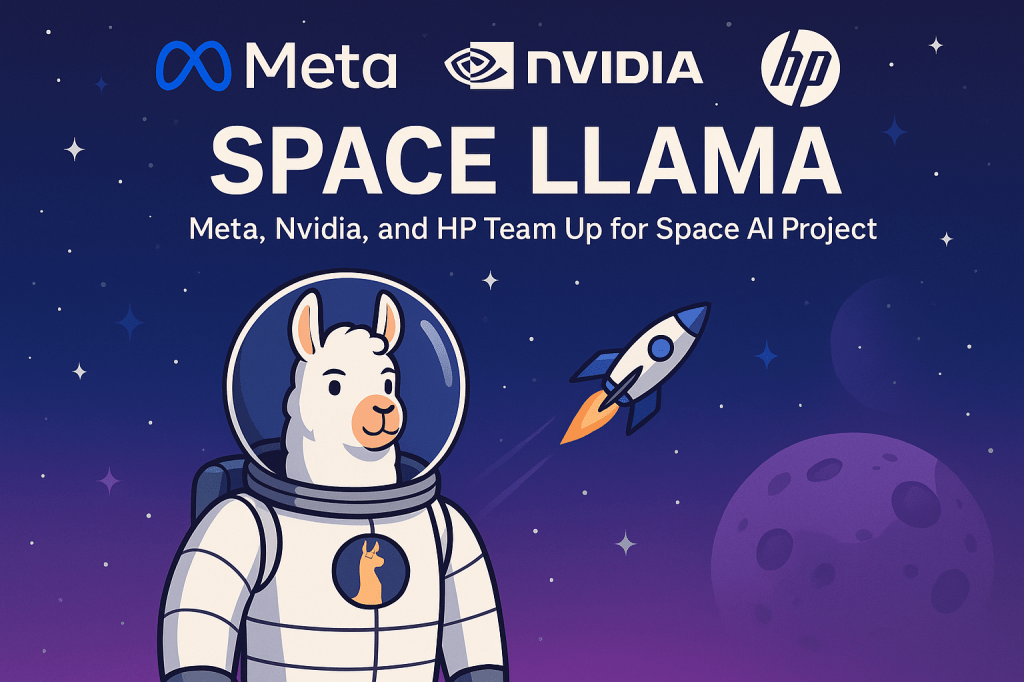
In a groundbreaking move that underscores the convergence of artificial intelligence and space exploration, Meta, Nvidia, and HP have announced a collaborative initiative dubbed “Space Llama.” This ambitious project aims to deploy advanced AI models in extraterrestrial environments, marking a significant stride in the application of AI beyond Earth.
The Genesis of Space Llama
“Space Llama” is envisioned as a pioneering endeavor to integrate Meta’s cutting-edge Llama AI models with Nvidia’s high-performance computing capabilities and HP’s robust hardware solutions. The objective is to develop AI systems capable of operating autonomously in the challenging conditions of space, facilitating tasks ranging from data analysis to decision-making processes aboard spacecraft and extraterrestrial habitats.
Meta’s Llama models, particularly the latest iterations like Llama 4, have demonstrated remarkable proficiency in natural language processing and reasoning tasks. These models are trained on vast datasets using extensive GPU clusters, with reports indicating the utilization of over 100,000 Nvidia H100 GPUs for Llama 4’s development . Such computational prowess ensures that the AI systems possess the necessary capabilities to handle complex operations in space missions.WIRED+2The Verge+2Barron’s+2Informa TechTarget+9WinBuzzer+9WIRED+9
🧠 Meta’s Llama: A Leap in AI Capabilities
Meta’s commitment to advancing AI is evident in its substantial investments in infrastructure and model development. The Llama 4 series, including models like Llama 4 Scout and Llama 4 Maverick, showcases significant improvements over previous versions, offering enhanced performance in various benchmarks . These models are designed to be efficient, with Llama 4 Scout capable of running on a single Nvidia H100 GPU, making them suitable for deployment in environments with limited computational resources.Barron’s+6Analytics India Magazine+6WinBuzzer+6The Verge+8The Verge+8Barron’s+8
Furthermore, Meta’s open-source approach to AI development fosters collaboration and innovation, allowing for the adaptation of Llama models to specific use cases, such as those encountered in space exploration.
⚙️ Nvidia and HP: Powering the Mission
Nvidia’s role in the Space Llama project is pivotal, providing the necessary GPU technology to train and run the sophisticated Llama models. The company’s H100 GPUs are at the forefront of AI computing, offering unparalleled performance that is crucial for processing the vast amounts of data generated during space missions.
HP contributes its expertise in hardware solutions, ensuring that the AI systems are supported by reliable and durable computing platforms. The company’s recent developments in AI PCs and workstations, equipped with Nvidia’s RTX Ada Generation GPUs, demonstrate its capability to deliver high-performance computing solutions suitable for demanding environments .NVIDIA Blog
🌌 Implications for Space Exploration
The integration of advanced AI systems into space missions holds the potential to revolutionize the field. Autonomous AI can assist in real-time data analysis, anomaly detection, and decision-making, reducing the reliance on Earth-based control and enabling more efficient operations. This is particularly beneficial for missions to distant planets or moons, where communication delays can hinder timely responses.
Moreover, AI can play a crucial role in the maintenance and operation of spacecraft systems, predicting potential failures and suggesting preventive measures, thereby enhancing the safety and success rates of missions.
🌍 Broader Impact and Future Prospects
Beyond space exploration, the advancements achieved through the Space Llama project are likely to have far-reaching implications. The development of AI systems capable of operating in extreme and isolated environments can be translated to applications on Earth, such as in deep-sea exploration, disaster response, and remote scientific research.
Furthermore, the collaboration between Meta, Nvidia, and HP sets a precedent for cross-industry partnerships aimed at tackling complex challenges through technological innovation. As AI continues to evolve, such collaborations will be instrumental in pushing the boundaries of what is possible.
🔭 Looking Ahead
The Space Llama project represents a significant milestone in the integration of AI into space exploration. By leveraging the strengths of Meta’s AI models, Nvidia’s computing power, and HP’s hardware solutions, the initiative is poised to enhance the autonomy and efficiency of space missions.
As the project progresses, it will be essential to address the challenges associated with deploying AI in space, including ensuring reliability, managing limited resources, and safeguarding against potential failures. However, the potential benefits underscore the importance of such endeavors in advancing both space exploration and AI technology.
 JustAIGuide
Leave a comment