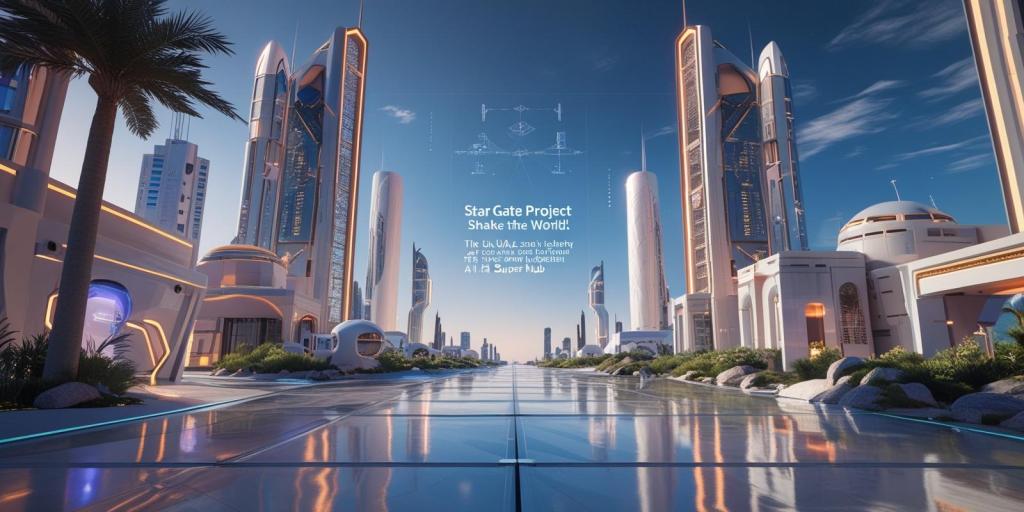
In a landmark move set to redefine global tech power dynamics, the United Arab Emirates and the United States have officially launched the Star Gate Project—a colossal joint venture aimed at building a 5-gigawatt AI super hub. Hailed as one of the most ambitious undertakings in the history of computing, this project signals a new era of ultra-scale data infrastructure, intelligent innovation, and international collaboration.
A Gateway to the Future of AI
The Star Gate Project is not just another data center. It is a futuristic AI-centric computing campus designed to deliver unprecedented computing power for training and deploying large-scale artificial intelligence models, including LLMs (Large Language Models), computer vision systems, and autonomous systems. With a projected power capacity of 5 gigawatts, it will surpass the world’s current largest AI computing clusters in both scale and efficiency.
The initiative is expected to support the next generation of global AI development—be it in scientific research, healthcare, climate modeling, defense, or enterprise innovation.
Strategic UAE-USA Collaboration
The announcement of this joint effort between the UAE and the USA highlights a powerful geopolitical and technological alignment. The UAE has been aggressively investing in advanced technologies, from space exploration to AI governance. Meanwhile, the USA brings its unmatched technological know-how and leadership in the AI ecosystem.
By combining financial power, political will, and technical capability, the two nations are sending a strong message: AI supremacy requires global cooperation and massive infrastructure.
Why 5 Gigawatts Matters
To put the Star Gate Project’s scale into perspective, 5 gigawatts is enough to power over 3.5 million homes. In the AI world, that translates into running millions of GPUs, petabytes of memory, and exabytes of storage—all working seamlessly to process trillions of data points in real time.
This level of power will provide the backbone for training foundation models, conducting quantum-level simulations, and hosting decentralized AI networks. It also sets the stage for green computing practices by integrating renewable energy sources and next-gen cooling systems to minimize environmental impact.
Economic and Global Impact
This super hub is not just a tech feat—it’s a global economic catalyst. With the emergence of Star Gate, the UAE is likely to become the AI infrastructure capital of the Middle East, attracting leading global tech firms, startups, research institutions, and talent from across the world.
Moreover, it strengthens the region’s economic diversification goals while creating thousands of jobs in cloud engineering, data science, cybersecurity, and clean energy sectors. For the USA, the project reinforces its influence in international AI governance while ensuring strategic access to next-gen infrastructure in a rapidly transforming digital world.
What’s Next?
While the first phase of construction is expected to begin in the coming months, experts predict that once complete, the Star Gate will be the world’s most advanced AI compute zone—a launchpad for everything from AGI experiments to real-time global simulations.
Some anticipate the project will also become a testing ground for AI ethics, regulation, and safe development, potentially hosting collaborative governance frameworks between East and West.
Final Thoughts
The Star Gate Project is not just shaking the world—it’s reshaping it.
With a 5-gigawatt backbone, deep cross-border collaboration, and a vision for responsible AI, this initiative is a testament to what’s possible when nations unite for a smarter, more connected future. Whether you’re in tech, policy, or education, one thing is clear: The AI revolution now has a launchpad, and it’s massive.
 JustAIGuide
Leave a comment