
What if you could write a full short story, a gripping thriller, or a fantasy epic — in under 10 minutes — completely for free?
That’s not a dream anymore. It’s Tuesday.
AI storytelling tools have quietly become one of the most powerful creative technologies of our time. Whether you’re a blogger, a novelist, a teacher, or just someone who loves a good story. AI can now help you brainstorm, draft, expand, and polish stories at a speed that was unimaginable just two years ago.
But here’s the problem: there are hundreds of AI writing tools out there, and most of them cost money, are confusing to use, or simply don’t produce great results.
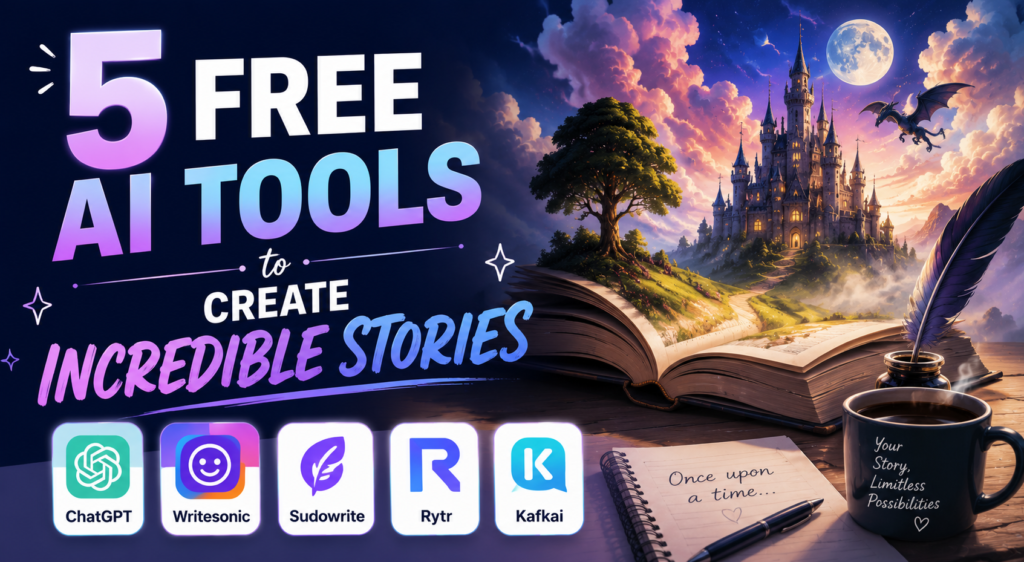
That’s why I’ve done the research for you. In this post, I’m breaking down the 5 best free AI tools specifically built for story creation — with real examples, key features, and exactly who each tool is best for.
Let’s begin.
Why AI Storytelling Tools Are Exploding
We are living in the golden age of storytelling — and AI is the new printing press.
The demand for stories has never been higher. Podcasts, YouTube, blogs, social media, video games, screenplays — every platform runs on narrative. Yet most people struggle to write consistently because of three barriers:
- Writer’s block: staring at a blank page with no idea where to start
- Time: crafting a well-structured story takes hours or even days
- Skill: knowing how to build plot, character, and tension is a craft that takes years to learn
AI storytelling tools eliminate all three barriers. They give you a starting point, help you build momentum, and use pattern recognition trained on millions of stories to guide your narrative instincts.
The result? Anyone can now tell a compelling story, and you can start for free.
Tool #1: ChatGPT (OpenAI) — Best for Full Story Generation
Website: chat.openai.com | Free Plan: Yes — GPT-3.5 is free forever
What Is ChatGPT?
You’ve probably heard of ChatGPT. But have you used it as a serious story-writing tool? Most people haven’t. They use it to write emails or answer questions — and completely miss the fact that it’s one of the most powerful story generators ever created.
ChatGPT is built on OpenAI’s language models and has been trained on a colossal library of fiction, screenplays, mythology, folk tales, and literary classics. This means it doesn’t just write, but also writes with narrative intelligence.
Key Features (Free Tier)
- Full story generation from a single prompt
- Character development and dialogue writing
- Genre-specific writing: horror, romance, sci-fi, fantasy, mystery
- Story continuation — pick up where you left off
- Plot twist suggestions and conflict resolution
- Editing and rewriting existing drafts
Real-World Example
Let’s say you want to write a short horror story for your blog’s Halloween special. You type this prompt:
“Write a 600-word psychological horror story about a woman who starts receiving voicemail messages from her own number — but the voice is not hers. Set it in a rainy small town. End with a twist.”
Within 30 seconds, ChatGPT produces a fully structured story, complete with atmosphere, tension, character emotion, and a spine-chilling ending. You can then ask it to ‘make it darker,’ ‘add more dialogue,’ or ‘rewrite the ending.’
Uses for Bloggers & Writers
- Generate short stories to publish on your blog weekly
- Create sample fiction for writing tutorials and workshops
- Draft story outlines before writing manually
- Write children’s bedtime stories for a parenting blog
- Generate story premises for a creative writing newsletter
Pro Tip: Always give ChatGPT a genre, setting, character, and desired emotion in your prompt. The more specific you are, the more cinematic and original the story becomes.
Tool #2: NovelAI — Best for Long-Form & Interactive Fiction
Website: novelai.net | Free Plan: Yes — free trial with limited generation
What Is NovelAI?
NovelAI is built specifically for writers, but not general AI users. It was designed by people who love storytelling, and it shows. Every feature of NovelAI is aimed at one goal: helping you write the best possible fiction.
Unlike general AI tools, NovelAI has been trained primarily on literary fiction, fantasy novels, anime light novels, and creative writing communities. This gives its output a distinctly literary quality because it understands narrative pacing, foreshadowing, and stylistic voice in a way that general AI tools often miss.
Key Features (Free Tier)
- AI-assisted long-form story writing
- Story memory system — it remembers characters, settings, and plot points
- Lorebook feature: build a full story bible with custom world details
- Multiple writing models trained on different fiction styles
- Choose your narrative style: serious, whimsical, dark, romantic
- First-person, second-person, and third-person modes
Uses for Bloggers & Writers
- Write serialized fiction for your blog (one chapter per week)
- Create interactive ‘choose your own adventure’ stories
- Build detailed fantasy or sci-fi worlds with consistent lore
- Write fan fiction with custom characters and settings
- Experiment with literary styles: gothic, noir, magical realism
Pro Tip: Use NovelAI’s Lorebook feature before you start writing. Define your main characters, key locations, and story rules. This single step will make every AI-generated continuation feel 10x more consistent and immersive.
Tool #3: Sudowrite — Best for Creative Writers Who Want AI as a Co-Author
Website: sudowrite.com | Free Plan: Yes — free trial (first 10,000 words free)
What Is Sudowrite?
Sudowrite is the AI tool that professional fiction writers actually use. It was co-founded by a novelist and built in close collaboration with the writing community. The result is an AI tool that thinks like a writer but not like a search engine.
What makes Sudowrite unique is its suite of story-specific tools. It doesn’t just generate text, but it helps you ‘show not tell,’ brainstorm metaphors, rewrite scenes with more sensory detail, and even analyze the emotional arc of your story.
Key Features (Free Trial)
- Write feature: generates the next part of your story
- Describe feature: adds rich sensory detail to any scene
- Rewrite feature: offers 8 different rewrites of any paragraph
- Brainstorm feature: generates plot ideas, character backstories, twists
- Story Bible: auto-generates a full character and world reference
- Feedback tool: gives editorial notes on your writing
Uses for Bloggers & Writers
- Turn mediocre scenes into emotionally powerful ones
- Get unstuck when you don’t know what happens next
- Write short stories for literary magazines and contests
- Create emotionally rich character-driven blog posts in story format
- Use as a writing coach that gives scene-by-scene feedback
Pro Tip: Use Sudowrite’s ‘Rewrite’ feature when you know what you want to say but can’t find the right words. Getting 8 variations instantly is like having a writing partner who never gets tired or frustrated.
Tool #4: Canva Magic Write — Best for Visual Storytellers & Bloggers
Website: canva.com | Free Plan: Yes — free plan includes Magic Write credits
What Is Canva Magic Write?
Canva is already the world’s most popular design tool. But most people don’t know it also has a powerful AI writing feature built right in: Magic Write. For bloggers and content creators who combine storytelling with visuals, Canva Magic Write is a dream tool.
It lets you generate story content, blog narratives, social media captions, and creative writing and immediately drop it into a beautifully designed layout. No switching between tools. No copy-pasting. Just create and design in one place.
Key Features (Free Plan)
- AI story and content generation inside Canva
- Generate stories directly into designed templates
- Children’s book story creation with matching visuals
- Social media story posts (Instagram, Facebook, LinkedIn)
- Blog post drafts with instant visual formatting
- Presentation stories and narrative slide decks
Real-World Example
You run a children’s education blog and want to publish a short illustrated story about a curious little robot who learns to make friends. In Canva, you open a children’s book template, type your story idea into Magic Write, and it generates a sweet, age-appropriate story in seconds. You then add AI-generated illustrations using Canva’s image tools, and you have a fully designed, publish-ready illustrated story — for free.
Uses for Bloggers & Writers
- Create illustrated children’s stories for an education blog
- Write and design story-based Instagram carousel posts
- Build narrative-driven presentations and pitch decks
- Create story infographics that walk readers through a journey
- Design and write branded storytelling content for businesses
Pro Tip: Combine Canva Magic Write with Canva’s AI image generator to create fully illustrated short stories. This is especially powerful for children’s blogs, educational content, and social media storytelling.
Tool #5: Claude (Anthropic) — Best for Nuanced, Thoughtful Storytelling
Website: claude.ai | Free Plan: Yes — generous free plan
What Is Claude?
Claude is Anthropic’s AI assistant, and when it comes to storytelling, it brings something most AI tools lack: nuance, emotional depth, and narrative wisdom. Claude has been trained with a strong emphasis on understanding human values, complex emotions, and moral complexity, which means the stories it writes feel genuinely human.
It also excels at stories with moral dilemmas, complex characters, subtle plot development, and themes that actually make readers think. If you want a story that goes beyond surface-level plot and touches something real, Claude is your tool.
Key Features (Free Plan)
- Deep character development with internal conflict and growth
- Morally complex stories with no easy answers
- Literary-quality prose with strong voice and atmosphere
- Long story generation with consistent plot and theme
- Genre versatility: literary fiction, thriller, romance, sci-fi, fable
- Story feedback and developmental editing suggestions
Pro Tip: When using Claude for stories, ask it to ‘write in a literary style with strong sensory detail and a morally complex protagonist.’ This single instruction unlocks a quality level that feels genuinely publishable
Final Thoughts: Your Story Deserves to Be Told
Here’s a truth most people don’t say out loud: everyone has a story worth telling. The grandfather’s war memories. The immigrant mother’s journey. The midnight panic attack that changed everything. The strange, beautiful, broken moment that nobody else would understand.
For generations, those stories went untold because writing is hard, time is short, and most people never believed they were ‘a writer.’
AI storytelling tools have changed that equation forever.
You don’t need to be Hemingway or have a writing degree. You should not spend months drafting and redrafting. All you have to work on is the right tool and the courage to begin.
The five tools in this post, ChatGPT, NovelAI, Sudowrite, Canva Magic Write, and Claude, are all free to start. Each one offers something different. Together, they represent the most powerful storytelling toolkit that has ever existed.