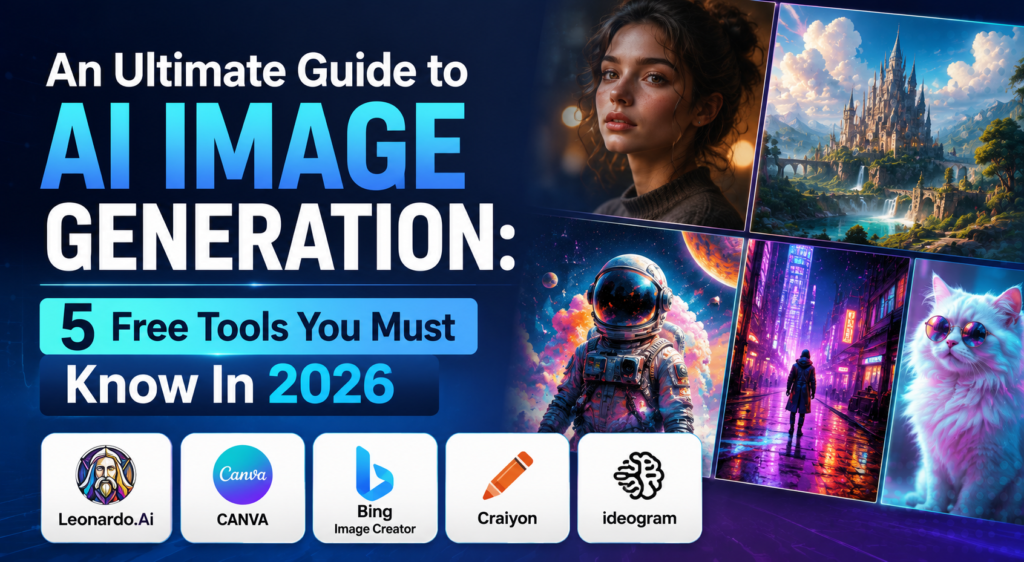

In the rapidly evolving landscape of 2026, AI-generated imagery has transitioned from a technical novelty to an essential pillar of modern digital creation. Whether you are a professional marketer building a high-converting landing page, a content creator needing custom visuals for social media, or a hobbyist looking to explore the fringes of your imagination, the barrier to entry has never been lower—or more powerful.
We are currently living in a “Golden Age” of synthetic media. Where once you needed thousands of dollars in software and years of design training to produce high-end visuals, you now only need a clear vision and the right prompt. Today, we are diving deep into the five most robust AI image generators that offer significant, high-quality free tiers, helping you decide which one should become your new creative partner.
1. Microsoft Designer
Microsoft’s integration of OpenAI’s DALL-E 3 within the Microsoft Designer ecosystem has fundamentally changed how we interact with AI. It is arguably the most frictionless gateway for anyone looking to bridge the gap between “text” and “pixel-perfect art.”
The beauty of Microsoft Designer lies in its intelligence. Unlike older models that required complex “prompt engineering” (stringing together obscure keywords to get a result), DALL-E 3 is designed to understand natural language. You can talk to it like you would a human assistant. If you ask for something specific, it understands the context, the mood, and the relationship between objects in the frame.
It is effectively “unlimited.” While you receive “boost tokens” for faster generation, the system allows you to keep creating even after they run out—the images just take a little longer to render. This makes it the most reliable tool for iterative learning.
2. Google Gemini: The Integrated Powerhouse
Google’s Gemini has rapidly ascended the ranks to become a dominant force in generative AI. By leveraging Google’s massive, multimodal datasets, Gemini offers a unique advantage: it understands the world, landmarks, and technical concepts with unparalleled accuracy.
Gemini is not just an image generator; it is a research assistant that happens to be an artist. When you ask it to create an image, it draws from a deep well of world knowledge. If you ask for a “Gothic cathedral in the style of 19th-century sketches,” it doesn’t just guess—it references the architectural motifs associated with that era.
The free tier is exceptionally generous. For users who need to generate hundreds of images to find the “perfect one,” the high daily limits ensure you aren’t interrupted by a paywall.
3. Leonardo.ai: The Artist’s Playground
If you feel restricted by simple chat-based generators, Leonardo.ai is the professional-grade upgrade you need. It is designed for users who want to move beyond a simple output and into the realm of custom-tuned, style-specific art.
Leonardo functions more like a digital studio. It provides a variety of pre-trained models—from “Anime/Manga” to “Photorealism” and “RPG Items.” You can adjust the “Guidance Scale” (how strictly the AI follows your prompt), add negative prompts (what you don’t want to see), and even use features like “Canvas” to expand or edit existing images.
The platform offers a daily allocation of “tokens” that replenish, allowing you to experiment with different models every single day. It is the best place to go if you are building a consistent brand identity or a long-term character project.
4. Adobe Firefly: The Professional’s Choice
Adobe has taken a different approach to AI. By training Firefly exclusively on Adobe Stock images and public domain content, they have created a “commercially safe” model. This is a game-changer for businesses and freelancers who are worried about copyright and intellectual property.
Firefly feels like a design tool rather than a playground. Its interface is clean and encourages you to adjust specific parameters—aspect ratios, content types (photo vs. art), lighting, and camera angles—using simple, tactile menus rather than complex code.
If you use Adobe Creative Cloud, Firefly’s “Generative Fill” is a lifesaver. You can take an existing photo, highlight a section, and tell the AI to “add a vase of flowers” or “change the sky to a sunset.” It is the most seamless way to integrate AI into your existing workflow.
5. Ideogram: The Typographic Champion
Historically, AI struggled with text—it would output letters that looked like alien hieroglyphics. Ideogram has effectively solved this problem, making it the premier choice for anyone who needs signage, logos, or graphic design elements.
Ideogram is built with a “text-first” architecture. If you need a birthday card with a specific name, a book cover with a title, or a logo with a tagline, this is the tool that will get it right on the first or second try.
It is the only tool on this list that feels like a full-service graphic designer. By focusing on prompt adherence and typography, it removes the need to take your AI images into Photoshop to “fix the spelling” manually.
Mastering the Workflow: A Strategic Approach
Knowing the tools is only half the battle. To truly leverage these generators, you must adopt a strategic mindset. Here are three principles to maximize your results:
- Iterate, Don’t Settle: The first result is rarely the best one. Use the “variations” feature provided by these tools to refine your initial generation.
- Combine the Strengths: Don’t be afraid to use a mix of tools. Use Ideogram to create your logo, and then use Adobe Firefly to place that logo onto a photo mockup.
- The “Prompting” Skillset: Treat your prompt like a brief. Start with the Subject, follow with the Setting, add Lighting/Style, and finish with the Technical Specs (e.g., “shot on 35mm,” “high resolution,” “unreal engine 5 render”).
Conclusion:
As we move through 2026, the question is no longer “Can AI generate this?” but rather “Which AI will generate it most efficiently?”
- For the casual creator: Start with Microsoft Designer. Its ease of use and seamless integration make it the best starting point.
- For the data-driven professional: Lean into Google Gemini. Its vast knowledge base and speed are unmatched for quick, high-quality results.
- For the digital artist: Leonardo.ai is your sanctuary. The control it offers is simply unmatched by more “mainstream” tools.
- For the business owner: Adobe Firefly is your safest bet, ensuring your content is commercially sound and fits perfectly within the Adobe ecosystem.
- For the graphic designer: Ideogram is the secret weapon that will save you hours of post-production text editing.
The democratization of visual intelligence is here. By mastering these five tools, you aren’t just keeping up with the technology—you are positioning yourself at the forefront of the creative revolution. The only limit remaining is the quality of your curiosity. Start experimenting today, and see where these tools take you.


Pingback: 5 AI Tools to Create Images for Free- 2026 Beginners’ Guide - JustAIguide
Pingback: 5 Free AI Tools to Create Videos in 2026 - JustAIguide