
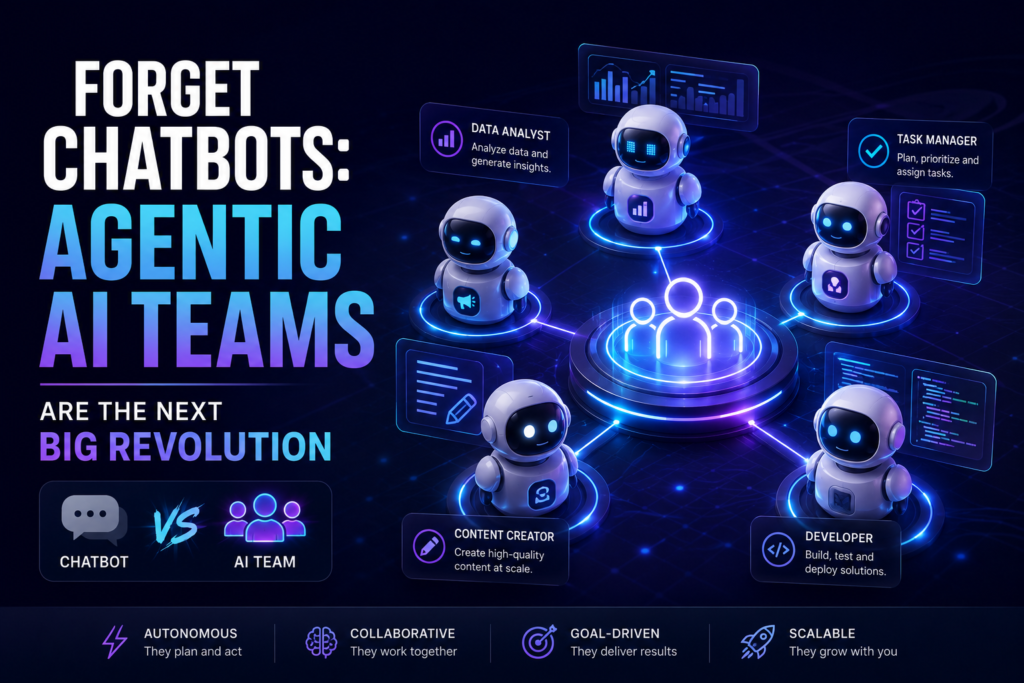

Everyone knows a chatbot is built for one thing: answering your questions. You ask, it replies, and until you ask again, it stays silent. An agent works completely differently. It doesn’t wait for a single question; it works toward a specific goal. It takes its own steps, searches for information, checks data, and uses different tools or apps to actually finish the task, not just talk about it. A chatbot waits for your question before giving a pre-trained answer, while an agent is proactive. It understands a bigger goal, reasons through the constraints in front of it, and adjusts its actions when things change.
I have even heard about agents that don’t need a command at every single step, handling multiple tasks at once, almost like an AI quietly working in the background on your device instead of some robot standing in front of you.
The Agentic AI topic actually matters right now, not just for professionals and big companies running huge projects, but for regular people too, even though a simple chatbot is still enough for most everyday needs.
What an Agentic AI Team Actually Looks Like
When people say AI agents work as a “team,” they mean several agents working together, each handling a different job, almost like departments inside a company. One agent might handle research, another handles the coding, and a third acts as the “orchestrator,” coordinating everyone like a digital team lead. This isn’t just theory; real companies are already doing it. Toyota, for example, uses an agentic tool to track vehicle arrival times at dealerships and is now starting to use agents to resolve supply issues on their own, often finishing the work before staff even arrive in the morning. It’s a shift from a single tool doing one job to a whole system quietly working together in the background, each part playing its own role without needing someone to manage every single step.
The Risks Nobody Should Ignore
On the flip side, the safety and security part of this can get pretty scary if AI agents are left completely on their own without any human keeping an eye on things. Mistakes could slip through unnoticed, security risks could grow, and job loss could increase too, along with a few other issues we have not even thought of yet. But companies moving fast into this also means they are gaining real experience along the way so they may already be handling their own safety checks as they go. This can still be seen as a natural progression of technology but companies need to stay careful about that one worst-case moment a single wrong call from an agent, or one small error, that ends up causing big trouble across an entire automated system. That’s the part that should never be brushed aside just because the technology feels impressive.
Who Actually Needs These Companies or Regular People
When it comes to full agentic AI teams that setup really suits companies more than anyone else since they have a lot of work stacked on their shoulders and need multiple agents handling different parts of it at once. Regular people don’t need anything that heavy. A single AI agent or personal assistant the kind we already know like ChatGPT, Claude, or Gemini, is more than enough for everyday needs. But if someone’s curious and wants to actually experience what an AI agent feels like the first step is simple: learn about it a little before jumping in then just pick one tool you like and try it out for yourself.
Which Tools Are Actually Worth Looking At
I honestly didn’t expect these AI chatbots to do much more than just answer a question, but here is what I actually tell someone about which tool to pick. For regular people looking for a single AI assistant, the three names available everywhere are ChatGPT, Claude, and Gemini. ChatGPT is the most widely known and has the broadest ecosystem of plugins and tools. Claude is known for handling long documents well and giving thoughtful, natural-sounding writing help. Gemini ties in closely with Google apps like Gmail, Docs, and Calendar, so it’s a natural fit if someone’s whole life already runs on Google. None of these are full agent teams; they are single assistants, but they can still feel like a team helping you if you know how to ask them the right way.
For companies wanting actual agentic AI teams, where multiple agents work together on different jobs, tools like Zapier, n8n, and Lindy come up often. Zapier connects thousands of other apps together and can pull AI actions automatically across an entire workflow. n8n does something similar but is built more for technical teams who want to host and control things themselves. Lindy lets you build custom AI agents for specific jobs, like handling email, scheduling, or customer follow-ups, and once one is set up, it just keeps running on its own.
Final Thoughts
If there’s one thing I did want a reader to take away from all of this, it’s simple: use these tools for help, not as something to depend on completely. Be careful and think before you use them; don’t hand everything over blindly. That said, I am not against using them either; times have changed, and this is the age of technology now. The right approach is not to resist it, but to take steps forward with it, carefully and one at a time, as part of this progression rather than standing outside of it.