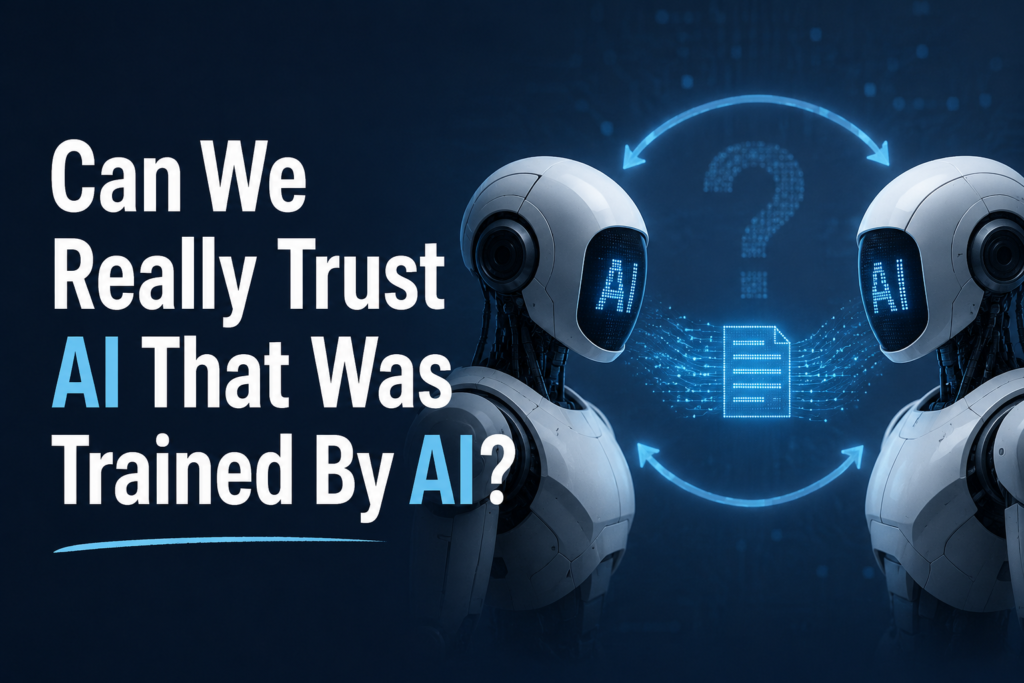

When AI was first created, it learned from human-written text, books, articles, and real human knowledge and experience. That was its foundation. But now in 2026, a huge portion of the internet is written by AI itself. Blog posts, social media comments, and product descriptions are all increasingly generated by AI. And here’s where something dangerous started happening. When new AI models are trained on this AI-generated content, the quality gets worse with every generation. Think of it like a rumour spreading from person to person. The first person tells it accurately. The second person changes a small detail. By the tenth person, the story is completely different from the original. AI trained by AI works the same way. Each generation loses a little more richness, diversity, and real human knowledge. Researchers at Oxford and Cambridge actually proved this by training AI on AI-generated data again and again, and after as few as 9 or 10 generations, the output became complete nonsense. So the real question is this: can we actually trust AI that AI trained?
What Makes Human Writing Different From AI
AI and human thinking are totally different things. When a human writes something, they bring their own emotions, personal experiences, opinions, and their own way of seeing the world. No two humans write the same way. AI has none of this. It doesn’t have emotions, personal experience, or real opinions of its own. It only takes your question and gives you an answer based on patterns it learned from other texts, and when that text was itself written by another AI, it gets even further away from real human thought. That’s probably why human writing still feels more natural and more trustworthy, and it’s exactly why so many people nowadays are going back to writing their own articles and their own books instead of depending fully on AI.
Fake Faces And Fake Facts
Here’s the thing: in this world, there are good people and bad people, and some bad people use AI to spread fake posts on social media, especially about famous people or celebrities, because most people don’t check if it’s actually true; they just trust it and share it. I saw something similar happen myself. My teacher was explaining a history topic in class, and later, when I asked AI to confirm it, AI actually gave me the wrong answer, even though I already knew what the real fact was from my teacher. That moment made me realize how easily AI can be confidently wrong and how dangerous that is for someone who doesn’t already know the real answer.
The Trap Of Blindly Trusting AI
If people blindly trust AI that was trained on other AI content, the results can be seriously harmful, and it can end up affecting systems around the world that are increasingly built on AI. People get confused and keep getting wrong or false answers without even realizing it. A student, depending on AI for homework, could get the wrong answer, submit it with full confidence, and later feel embarrassed or lose self-confidence when the mistake comes out. A doctor using AI-generated medical information that itself came from other AI content could end up recommending the wrong treatment to a real patient. We also hear a lot about fake resumes now, people needing a job and using AI to build one that looks impressive but turns out to be completely fake when you actually check it. Same with fake reviews on online shopping sites and even some government schemes or offers that sound real but turn out to be fake too. What starts as one small mistake in one generation of AI can quietly turn into a real mess with real consequences for real people.
So What Should We Actually Do
There’s no doubt AI has made human work a lot easier, and the point isn’t to stop using it; the point is to be smarter about how we use it. AI companies should focus on training their models on verified, genuine human content rather than recycling AI-generated text. On our side, as users, we also have a responsibility. Instead of blindly accepting whatever AI tells us, we should double-check it against real sources, real people, and real knowledge. Basically, use your own brain first and let AI support that, not replace it.
My Honest opinion
If a friend asked me right now, “Should I just stop using AI completely?” I honestly tell them, don’t stop using it just don’t fully depend on it either. Use it like a helper, not like the final answer to everything. Always verify what it tells you on other sites, too, and don’t treat it as your only option. AI can still be a genuinely useful tool for the future, but only if we stay a little alert and keep checking facts ourselves instead of letting AI quietly do all our thinking for us. The moment we stop questioning what AI tells us is the moment we lose track of what’s actually true.
At the end of the day, AI is still a tool built by humans for humans, and it works best when we stay in the driver’s seat instead of just sitting back and letting it decide everything for us. Maybe the real skill we need going forward is not learning how to use AI better, it’s learning when not to trust it blindly and staying curious enough to keep checking things for ourselves.