
The internet is flooded with AI-generated content. Blog posts, academic essays, marketing copy, and news summaries, a growing share of the words you read every day were written not by a human, but by a language model. And as AI writing tools have become more sophisticated, so too has the demand for tools that can identify them.
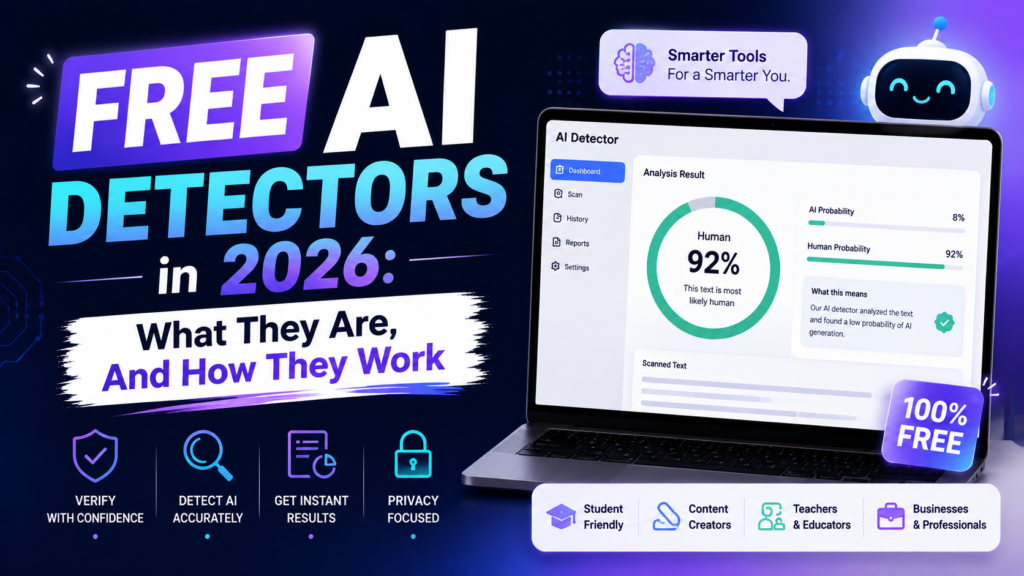
Enter the AI detector: software that analyzes a piece of text and tells you the probability that a machine wrote it. There are dozens of these tools on the market right now, and quite a few are free. But before you paste your student’s essay or a freelancer’s article into one of them and start making accusations, there’s a lot you need to understand about how they actually work, which ones are worth using, and what their scores can and cannot tell you.
This guide covers it all.
Why AI Detection Matters (and Why It’s Harder Than It Sounds)
When ChatGPT launched in late 2022, the panic was immediate particularly in education. Teachers and professors suddenly had no reliable way to tell whether a student had sat down and wrestled with an assignment or simply typed a prompt and submitted what came back. Content marketers faced a parallel problem: how do you verify that the freelancer you’re paying is actually writing, not just running your brief through an AI?
The need for a detector seemed obvious. The execution, however, is anything but straightforward.
Here’s the core problem: AI-generated text and human-generated text are not categorically different things. They’re made of the same words, follow the same grammatical rules, and cover the same ideas. What differs is the statistical pattern underneath. AI detectors try to measure those patterns and classify text based on which “distribution” it most resembles. That sounds clinical and reliable. In practice, it means these tools are educated guesses, smart ones, but guesses nonetheless.
How AI Detectors Actually Work
To use any AI detector intelligently, you need to understand the mechanics. Most tools rely on three key signals:
1. Perplexity
Perplexity measures how predictable a sequence of words is. Language models are trained to generate the most statistically likely next token meaning their output tends to flow in highly predictable, “low-perplexity” patterns. Human writing, by contrast, is often surprising: we choose unexpected words, go off on tangents, and make stylistic choices that defy pure probability.
Early AI detectors were built almost entirely on this signal, and it worked well in 2022 and 2023 when models like GPT-3 produced noticeably flat, predictable text. The problem is that modern frontier models GPT-4o, Claude 4, Gemini 2 have gotten dramatically better at producing varied, higher-perplexity output. The gap that early detectors exploited has largely closed. A 2026 AI detector relying primarily on perplexity is essentially fighting a problem that mostly disappeared in 2024.
2. Burstiness
Burstiness measures variation in sentence length and structural complexity across a passage. Human writers naturally write in “bursts.” A long, meandering sentence might be followed by a short one, then a fragment, then a clause-heavy compound sentence. The rhythm is unconscious and irregular, driven by shifts in thought and emphasis.
Older AI models wrote with unnatural uniformity: every sentence roughly the same length, every paragraph with the same rhythm, the whole thing reading like it was assembled on an assembly line. Modern AI tools have improved considerably here too, but burstiness remains a useful signal, particularly when combined with perplexity scores.
3. Classifier Models
The most sophisticated detectors go beyond perplexity and burstiness. They use neural networks trained on large labeled datasets of human writing and AI-generated text. These classifiers learn subtle statistical “fingerprints” of certain transitional phrases, certain structural patterns, and certain vocabulary choices that correlate with machine output rather than human output.
Most of the tools with serious accuracy claims in 2026 use some version of this approach, often combining the classifier with perplexity and burstiness scoring to produce a final probability estimate. The result is a number, say, “87% likely AI” that most users treat as definitive but which is really a statistical estimate with meaningful error margins.
The Accuracy Problem: What the Research Says
Here’s the uncomfortable truth that most AI detector marketing conveniently ignores: no free AI detector is anywhere close to perfect. Independent testing in 2026 found accuracy rates among popular free tools ranging from around 76% to 95%, and even the higher end of that range means roughly one in twenty texts is misclassified.
Those errors can be devastating. False positives, where the tool flags human-written text as AI are a serious concern. Research from Stanford found that GPT detectors wrongly classified writing by non-native English speakers as AI-generated more than 61% of the time. This happens because non-native English writers often score lower on perplexity and burstiness metrics for the same reason AI does: their writing tends to use more common vocabulary and simpler grammatical structures.
The implications are significant. A teacher using a free AI detector to discipline a student who wrote in their second language might be flagging entirely authentic work. An editor rejecting a freelancer’s article on the grounds might be making a false accusation. The score is not proof. It is a signal. And a noisy one at that.
The Best Free AI Detectors in 2026
With those caveats firmly in place, here are the free tools actually worth using and what each one is good for.
1. Scribbr AI Detector
Scribbr consistently ranks among the best free AI detectors in independent testing. In a comprehensive 2026 benchmark, Scribbr tied for the second-highest accuracy score among all tools tested, coming in at 78% on the free tier. The interface is clean, the tool is genuinely free with no signup required for basic use, and the results are presented clearly without overhyping their reliability.
Best for: Students, educators, writers who want a reliable free option without account friction.
2. QuillBot AI Detector
QuillBot’s AI detector is one of the most widely used free tools available. It performs comparably to Scribbr in head-to-head testing, and it has the advantage of integrating seamlessly with QuillBot’s broader writing ecosystem paraphrasing tools, grammar checkers, and citation generators.
The free tier allows up to 1,200 words per scan and six scans per day, which is sufficient for most casual use cases. The tool highlights sentences flagged as likely AI-generated, giving you a more granular view than a simple overall score.
Best for: Writers already in the QuillBot ecosystem; educators running quick spot-checks.
3. GPTZero
GPTZero was one of the first serious AI detectors, built by Edward Tian while he was a Princeton student, and it remains a top-tier option in 2026. The free tier gives you up to 10,000 words per month with sentence-level highlighting, one of the more generous free limits in the space.
GPTZero has become particularly popular in academic settings, where the sentence-level breakdown is more useful than a single aggregate score. It lets teachers identify which specific passages within a document are most likely AI-generated, which is both more informative and fairer than treating the whole submission as a binary pass/fail.
Best for: Educators and academic institutions; anyone who needs sentence-level analysis.
4. ZeroGPT
ZeroGPT offers a completely free, no-signup-required detector with no enforced word cap, making it the most accessible tool on this list for quick, frictionless checks. Accuracy is somewhat lower than Scribbr or QuillBot in rigorous testing, but the ease of access makes it a useful first-pass option when you just want a quick read on a piece of text before investing more scrutiny.
Best for: Quick first-pass checks with zero setup; anyone who doesn’t want to create an account.
5. Copyleaks AI Detector
Copyleaks comes from the plagiarism detection world, and its AI detector benefits from that background. The free tier allows scans of up to 25,000 characters per scan without logging in. Copyleaks has strong multilingual support, making it one of the better choices for detecting AI content in languages other than English.
Best for: Multilingual content review; users who need plagiarism detection alongside AI detection.
6. Sapling AI Detector
Sapling is oriented toward business and customer-facing content rather than academic use. It’s fast, free for short texts, and designed to flag AI-generated passages in things like customer service responses, marketing copy, and email drafts. The sentence-level highlighting is clean and useful.
Best for: Business users, marketers, and content editors checking short-form copy.
Choosing the Right Tool for Your Situation
The best AI detector for you depends almost entirely on your context:
- You’re a teacher checking student work: Use GPTZero. The sentence highlighting, academic focus, and 10,000-word monthly allowance make it the right tool. Pair it with draft history and class participation evidence before making any disciplinary decisions.
- You’re a content editor or publisher: Scribbr or QuillBot for regular spot checks. For high-volume work, consider whether a paid tool with higher accuracy is worth the investment.
- You need to check multilingual content: Copyleaks is your best starting point among free options.
- You just want a quick gut-check: ZeroGPT. No signup, no friction, results in seconds. Just don’t treat the number as definitive.
- You need to make a formal accusation or enforcement decision: Don’t rely on any free AI detector alone. Gather supporting evidence drafts, edit history, writing samples, direct conversation, and treat the detector score as one signal among many, not a verdict.
What AI Detectors Cannot Tell You?
This bears repeating: an AI detector score is a probability estimate, not a verdict.
A high “likely AI” score does not prove a piece was AI-generated. It means the text has statistical features that overlap with AI output. Those features can appear in human writing too, especially from non native English speakers, highly technical writers, or anyone with a clean, consistent prose style.
Conversely, a low “likely AI” score does not prove a piece was human-written. Someone who runs AI-generated text through humanizing tool services like Undetectable.AI that paraphrase and vary AI output can reliably defeat most free detectors. A 30-second pass through one of these tools is enough to bring most detector scores down significantly.
The tools have real value as a signal, particularly in aggregate. If five different detectors all flag the same passage, that’s worth a closer look. But no single score from a single free tool should be the basis for a consequential decision about someone’s work or integrity.
The Bottom Line
Free AI detectors in 2026 are better than they’ve ever been and still far from reliable enough to be treated as authoritative. The best free options, Scribbr, QuillBot, and GPTZero, offer real signal, reasonable accuracy, and useful features. But they work best as one layer in a broader review process, not as a standalone answer.
Use them intelligently: understand that they measure statistical patterns rather than intent, that they’re biased against certain types of human writing, and that a score above 80% is a reason to look more closely, not a reason to reach for the delete button.
The technology is improving. The arms race between detectors and humanizers is ongoing. But for now, the most important tool in AI detection isn’t software, it’s critical human judgment, informed by context and evidence that no algorithm can replicate.
Have you ever used these tools? Comment below.