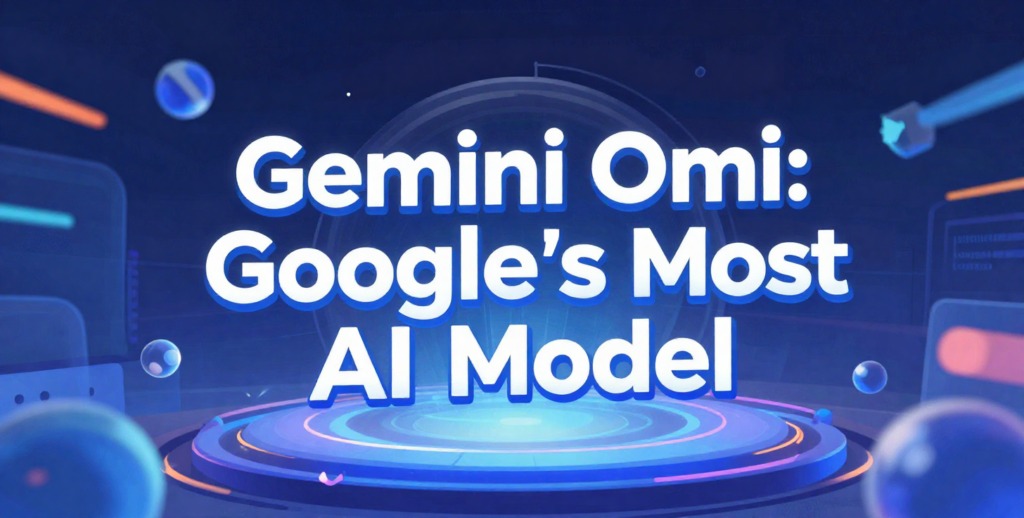

There’s a moment in every technology cycle when the product stops feeling like a tool and starts feeling like a collaborator. But with the unveiling of Gemini Omni at Google I/O 2026, we may have just crossed that line.
Google didn’t just release another model upgrade this May. It introduced something qualitatively different, a system that doesn’t merely answer questions or generate text, but one that can take any input you throw at it, video, audio, images, text, and produce rich, coherent, high-quality creative output from the other side. If the last generation of AI was about understanding the world, Gemini Omni is about making things in it.
Let’s unpack exactly what Gemini Omni is, why it matters, how it works, and what it means for creators, developers, and everyday users.
What Is Gemini Omni?
At its core, Gemini Omni is Google’s new multimodal generative model one that can accept virtually any combination of inputs and generate content across multiple output types from a single, unified system. As Google described it at I/O 2026, Omni is “capable of generating samples in any output modality from any input,” starting first with video outputs, with image and text generation to follow.
The keyword here is unified. Before Omni, Google’s generative media stack was fragmented: Veo handled video generation, Imagen handled images, and separate audio systems ran in parallel. Omni collapses all of that into a single architecture. Feed it a reference image, a snippet of audio, a piece of text, or a video clip, and Omni synthesizes these signals into one coherent creative output.
This isn’t just a workflow convenience. When reasoning and creation live inside the same model, you get outputs that are far more contextually aware. A video generated by Omni isn’t just visually plausible; it’s visible in Gemini’s real-world knowledge, which means it understands spatial relationships, temporal coherence, and narrative logic in ways that siloed generative models simply can’t.
The Launch: Gemini Omni Flash
Google launched the first member of the Omni family, Gemini Omni Flash on May 19, 2026, during the I/O keynote. Omni Flash is the faster, more accessible tier of the model, designed for broad consumer use and high-volume creative workflows.
Here’s what shipped on day one:
Video generation and editing up to 10 seconds per clip, with native audio baked in. Users can create from scratch or remix existing footage using simple conversational prompts, things like “apply a cinematic zoom” or “change the background to a winter forest.”
Any reference input support. Omni can turn any reference into an image, text description, video, or audio clip into a unified video output. Voice references are fully supported at launch, with additional audio input types and audio output generation on the near-term roadmap.
Transparent AI provenance via SynthID. Every single clip generated by Omni Flash carries a SynthID watermark, Google’s cryptographic content authenticity system. The watermark is verifiable through the Gemini app, Gemini in Chrome, and Google Search.
Broad availability from launch day. Omni Flash is rolling out globally to all Google AI Plus ($7.99/mo), Pro ($19.99/mo), and Ultra ($100/mo) subscribers through the Gemini app and Google Flow. For users on YouTube Shorts Remix and the YouTube Create app, it’s available at no cost to anyone 18 and older.
Why Omni Matters: The End of Siloed AI
To appreciate what Gemini Omni represents, it helps to understand the problem it’s solving. Until now, AI creativity has been fragmented by modality. Want to generate a video? Use one tool. Want to add a voiceover? Use another. Want to create a thumbnail from the same content? A third. Each system had its own prompting logic, its own aesthetic tendencies, its own failure modes. Stitching them together required technical skill, and even then, the seams showed.
Omni changes that equation fundamentally. Because it understands all input types within the same model, it can maintain consistency across a project in ways that separate tools cannot. A character’s face stays consistent from scene to scene. The mood of the audio matches the visual tone. The lighting logic remains coherent when you edit a single frame.
This is what Google means when it calls Omni “a huge leap forward in world understanding.” It’s not just that Omni can do more tasks, it’s that it understands the relationships between things across modalities, and that understanding shapes everything it creates.
Gemini Omni in Practice: Who Is It For?
Creators and Content Makers
YouTube creators, short-form video producers, and social media managers are probably the most immediate beneficiaries. The integration with YouTube Shorts Remix is particularly significant, as it means Omni isn’t a separate creative suite you have to learn; it’s embedded directly in the platform where the audience already lives.
The conversational editing interface in the Gemini app deserves special mention. Rather than learning a timeline editor or adjusting keyframes, you simply describe what you want: “make this feel more dramatic,” “cut to a wide shot,” “add rain to the background.” Omni interprets the instruction, executes the edit, and shows you the result. It’s video editing that works more like directing.
Developers and Enterprise Teams
The developer API for Omni Flash isn’t live yet, but Google has said it will roll out “in the coming weeks” via the Gemini API and Vertex AI, but it’s clearly the next major frontier. Once available, it will let development teams build Omni’s generation capabilities directly into their own products: marketing automation tools, content pipelines, educational platforms, accessibility applications, and much more.
Casual Users
Even for people who don’t think of themselves as “creators,” Omni opens up real possibilities. Want to animate a family photo into a short video clip? Remix a YouTube Short with a custom background? Turn a voice note into a polished video message? Omni Flash makes these things accessible through interfaces people already use daily.
The Bigger Picture: I/O 2026 and the Agentic Shift
Gemini Omni didn’t arrive in isolation. Google I/O 2026 unveiled a broader strategic vision that positions Omni as one pillar of what Google is calling the agentic era of AI, a shift from AI that responds to AI that acts.
Alongside Omni, Google launched Gemini 3.5 Flash, a model built specifically for complex, multi-step agentic workflows, coding, logical planning, and tool use. And then there’s Gemini Spark, designed for lightweight, always-on assistance.
Together, these three models represent a deliberate specialization: Omni handles creation, 3.5 handles action, and Spark handles ambient intelligence. As Google CEO Sundar Pichai framed it in his keynote, “AI is moving from a passive chatbot that answers questions to an active partner that completes multi-step, long-horizon tasks.” Omni is the creative expression of that ambition.
What’s Still to Come
Google was transparent about what Omni Flash doesn’t do yet and what’s next. The roadmap includes:
Longer clips and higher resolution. Current output is capped at 10 seconds per clip. Expanded clip lengths and higher-resolution output are confirmed on the roadmap, likely appearing first on the AI Ultra tier.
Richer audio modalities. Voice references work today, but more complex audio input types and, crucially, audio output generation are explicitly in development.
Omni Pro. The more powerful tier of the Omni family is on the horizon, expected to offer substantially higher quality outputs, longer generation windows, and photorealistic fidelity that competes with professional production workflows.
Developer API. The moment the Gemini API opens up for Omni Flash, expect a wave of third-party applications to emerge. The creative tools ecosystem could shift significantly once developers can build Omni directly into their products.
A Note on Transparency and Trust
It’s worth pausing on the SynthID watermarking, because it matters more than it might first appear. As AI-generated video becomes indistinguishable from real footage and Omni is moving in exactly that direction, the question of provenance becomes critical.
Google embedding this at the model level, rather than leaving it to platform policies, is meaningful. It signals an understanding that transparency needs to be built in from the start, not bolted on after the fact.
Final Thoughts
Gemini Omni is genuinely different from what has come before, not because it’s louder or shinier, but because it collapses a fundamental divide that has defined generative AI until now: the gap between understanding and creation.
For years, the best AI systems were brilliant at comprehending the world but clumsy at making things in it. Omni marks a serious attempt to close that gap. By combining Gemini’s reasoning depth with a unified generative architecture, it produces outputs that aren’t just technically impressive; they’re coherent, contextually grounded, and practically useful.
Whether you’re a creator looking to accelerate your workflow, a developer looking to build the next great content tool, or simply someone who wants to animate a memory and share it with people you love, Gemini Omni is worth paying attention to.